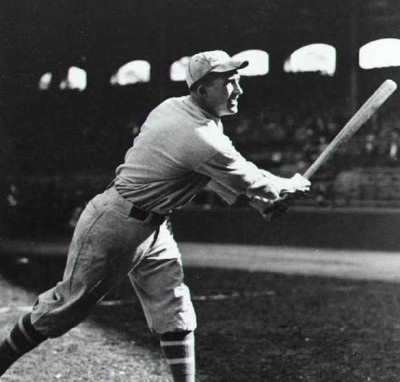
The July Sports Then and Now Athlete of the Month hit .462 while starting the first three All-Star Games during a stellar 20-year career that ended with his induction in the Baseball Hall of Fame.
One of the premier outfielders of his generation, Al Simmons was not as well known as Babe Ruth, but he was a steady run producer who helped the Philadelphia Athletics edge the New York Yankees for three straight American League titles from 1929-1931 while claiming two World Series titles. Read the rest of this entry →
The “Miracle Braves” of 1914 shocked the baseball world and made history when they won the franchise’s only World Series title in Boston.
The Atlanta Braves come back to their roots this weekend, as they come to their original home in Boston for a weekend series in Fenway Park with the Red Sox as interleague play continues. It’s been a long time since the Braves graced the sports world of the Hub, having relocated first to Milwaukee in 1953 and then to Atlanta in 1965. The fact the franchise left a baseball-crazed town tells you they never rose above playing second fiddle to the Red Sox. But in one glorious year the Braves gave the city a season to remember, one that still lives in on baseball lore for its miraculous turnaround and shocking World Series upset. With the franchise back visiting this weekend, BST&N looks back on 1914 and the year that belonged to Boston’s “Miracle Braves.”
Boston’s NL team was managed by George Stallings, on his third team in six years and looking for his first pennant. It was Stallings’ second year in Boston and his best player was second baseman Johnny Evers, closely followed by outfielder Joe Connelly. The latter led the team in most key offensive categories, while the former had such an exquisite balance of offensive and defensive prowess, that he won the American League MVP in the award’s fourth year of existence. The pitching staff was top-heavy, as most were in those days. Three pitchers—Dick Rudolph, Bill James and Lefty Tyler—combined to make 107 of the team’s 154 starts, and averaged over 310 innings apiece.
This talent alone wasn’t enough to make Boston a contender coming out of the gate though, and after the season started in mid-April, the Braves promptly lost 18 of their first 22. On June 8, they had fallen 13.5 games back of the pace being set by the New York Giants and the Cincinnati Reds. Lest you think the turnaround was imminent, the Fourth of July saw the Braves get swept in a doubleheader by the Brooklyn Dodgers, leaving them at 26-40, a good fifteen games back of the Giants and firmly buried in the cellar, with five games separating them from even reaching seventh in the eight-team National League.
It was the offense and winning close games that would key the dramatic turnaround about to start. The Braves would finish second in the National League in runs scored, while the pitching was in the middle of the league. They were third in home runs—back in this era, 62 led the league, so no one was making a living going deep. The Braves, showing they were firmly in line with what would become Boston sports tradition, were slow as molasses—at least relative to the competition. They stole 139 bases, last in the NL. This speed-oriented era saw 239 steals lead the league. There’s nothing in the overall statistical numbers that suggest a pennant-winning team, but one number does stand out. It’s the 33-20 record the Braves posted in one-run games, something that would ultimately give them a huge advantage over the Giants, who languished at 18-25.
Fate was not only smiling on the Braves, but by August, Fenway Park would be too. The old South End Grounds, the team’s regular home had been torn down and it wouldn’t be until the start of the 1915 season that Braves Field would be set to open. So at a time when Boston was closing the gap—they got the margin to nine games by the end of July and moved up to fourth place, and then swept three from the Giants in the Polo Grounds on August 13-15 to move within 3.5—they’d also be sharing space with their American League counterpart, who’d won the World Series just two years prior.
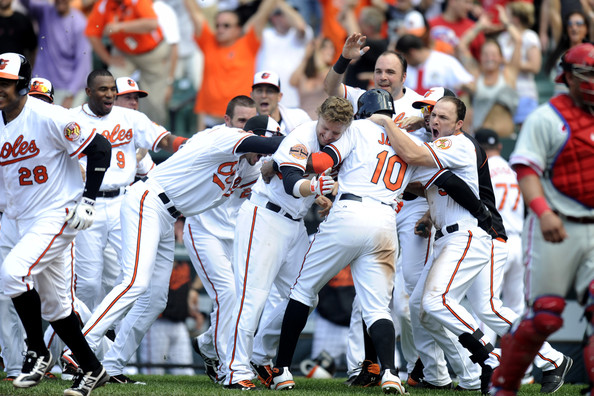
Late game celebrations have been a regular occurrence for the Baltimore Orioles is 2012.
If you are under the age of 35 you may find it hard to believe, but for nearly two decades, the Baltimore Orioles were the class of Major League Baseball and terms such as “The Oriole Way” and “Oriole Magic” were just as familiar to baseball fans as “Red Sox Nation” is today.
With the 2012 season now nearly a third of the way complete, it is way too early to declare Baltimore “back” among the upper echelon teams in baseball, but for the first time in quite a while the future in Baltimore does appear to be promising.
Following back-to-back extra inning victories over the Philadelphia Phillies, the Orioles sport an impressive 34-26 record and are right in the mix of the highly competitive American League East.
The hot early start is definitely a reason for fans of a franchise that hasn’t posted a winning record since 1997 to be excited, but this is not the first time in the last 15 years that Baltimore has teased fans into June.
In 2005 the Orioles had a 42-28 record on June 21st and a two game lead in the AL East. A 3-2 loss to the Toronto Blue Jays the next day started a stretch in which Baltimore lost 11 of 14 games and 60 of their final 92 games to end with a 74-88 record and 21 games out in the standings. Read the rest of this entry →
The Sports Then and Now Vintage Athlete of the Week for April is a former Major League shortstop who was never known for his offensive production, but was one of the best ever at fielding his position and was a key reason that his team was baseball’s best during his era.
Mark Belanger was such a valuable player for the Baltimore Orioles in the late 1960s and 1970s that he knocked a future Hall of Famer out of the Baltimore lineup and twice finished in the top 30 in the American League MVP despite hitting below .230 for the season. Read the rest of this entry →
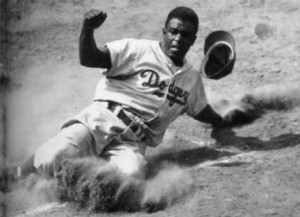
Jackie Robinson made his Major League Baseball debut on April 15, 1947.
Editor’s Note: In honor of today being the 65th anniversary of Jackie Robinson breaking baseball’s color barrier I am reprinting an article I originally published in recognition of the anniversary a year ago.
I am learning that one difficult challenge of being a parent is explaining to our children pieces from past history that are inconsistent with how we want them to think and experience daily life.
Recently my five-year-old son and I were watching a section from the wonderful Ken Burns Baseball documentary. The section first focused about baseball during World War II and then about Jackie Robinson breaking the color barrier in 1947.
Because he is growing up in a time and culture where racism isn’t a noticeable part of daily life and he has been fortunate in his short life to meet and regularly interact with many people from all backgrounds and races, it was very difficult for him to grasp that there was a time in our country when discrimination was part of the norm in certain places and where not everyone was given the same opportunities.
While trying to give him enough information to explain why Jackie Robinson was a special person and should be celebrated, I found myself focusing on how great Robinson was as a player, rather than simply focusing on his crucial role in breaking racial barriers. Not that I was trying to shield him from the ugly elements of America’s past, but rather because it was easier for him to understand and because what I want him to know as he moves forward with his own life is that people are judged and celebrated for their achievements, performance and success and that skin color isn’t an important part of that equation.
When you think about it, that is probably one of the greatest components of Jackie Robinson’s legacy. He paved the way for us to be able to judge greatness not based on ethnicity or race, but instead on how someone performs in whatever area in which they participate.
There are certainly still racial issues within our country, but while it is important for my son and all children to know and understand our history, things will continue to change as more generations of youngsters live through times where, to quote Martin Luther King Jr., “they will not be judged by the color of their skin, but by the content of their character”
It was 64 years ago today that Robinson played his first game as a member of the Brooklyn Dodgers. The future Hall of Famer didn’t get a hit that afternoon, but his mere presence forever changed professional baseball and American society.
During his rookie season, Robinson hit .297 and was named the National League Rookie of the Year.
Despite being 28 years old at the time of his major league debut, Robinson played 10 seasons for the Dodgers and helped them reach the World Series six times and claim the World Series title in 1955. He had a career batting average of .311 and was named the NL MVP in 1949.
In honor of Jackie Robinson Day across Major League Baseball, we are including several Youtube videos that celebrate his greatness both as a baseball player and as the man who paved the way for baseball to truly become the American pastime.
Tim Wakefield ended a great career in Boston last week.
The night was October 16, 2004 and a game, and another season was slipping away from the Boston Red Sox. Already trailing the New York Yankees two games to none in the American League Championship Series, the pitching in Game 3 was serving up batting practice fare to Yankee hitters. Tim Wakefield watched it unfold. He was scheduled to start Game 4, but stepped up and told manager Terry Francona that if need be, he (Wake) would give up his start and try and save the bullpen. Francona took him up on the offer.
Wakefield’s final line score showed that went 3 1/3 innings and gave up five runs in an 18-9 loss. A cynic might say his act of teamwork in giving up his start for a lost cause was pointless. But the innings he worked were the most of any Red Sox pitcher that night. It meant Francona got through the game without using Mike Timlin or Keith Foulke, while Alan Embree faced only a handful of batters. The core of the Sox bullpen was rested.
No one could have predicted what happened next. That not only would the Red Sox win the next four games in succession, but Games 4 & 5 would go a combined 26 innings, requiring every last bit of will from the bullpen and that Foulke would be needed again in Game 6, already running on fumes. But because Tim Wakefield put the interests of his team ahead of the interests of himself, even when it seemed like an act of futile martyrdom, the Red Sox were in position to pull off the miracle comeback. That’s why as he goes into retirement now, at age 45, that single act of selflessness should be his crowning memory.