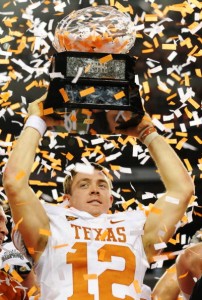
Colt McCoy and Texas won the Big 12 title, but not in the overwhelming fashion that most expected.
Okay, technically it looks like the powers that control the Bowl Championship Series (BCS) got exactly what they desired: an undefeated champion from the SEC against an undefeated champion from the Big 12. Seemingly a dream come true. Yet, thanks to a lackluster performance by the Texas Longhorns that dream has turned into a bit of a nightmare.
The purpose of the BCS formula is simply to ensure that the two best teams in college football meet in a championship game to decide the title. After enough situations over the years when teams like Penn State (multiple times), Alabama and others finished seasons undefeated, but without even a share of a national title, this concept seemed to make sense.
However, what has become painfully clear over the last decade is that it only works when there are clearly two teams that are better than all the rest.
The formula worked to perfection following the 2005 season when an undefeated Texas squad defeated a previously undefeated USC team in a game for the ages. However, in other years when two teams have not clearly been better than the rest, the system has received great criticism.
For most of the 2009 season it appeared that the BCS formula was going to work out perfectly. Unlike recent years when the top three spots in the BCS standings often proved to be a revolving door, in 2009 the three teams ranked at the top of the BCS standings in late October were all still there heading into the conference championship weekend.
With a pair of undefeated teams in the SEC and an undefeated Texas squad in the Big 12, it seemed clear that if Texas did as expected and annihilated Nebraska, then the Longhorns would face the winner of the Alabama-Florida game for the title in another epic matchup. Read the rest of this entry →
The injury to Ricky Stanzi in the Northwestern game changed the complection of the finals weeks of the season for the Hawkeyes.
The University of Iowa football team resumed practice Saturday inside the “dome” facility constructed during the Hayden Fry era, when the Iowa Hawkeyes became regular participants in postseason play. The team needed an indoor place to practice after cold weather arrived in Iowa in order to keep the team competitive.
As they hobbled onto the practice field Saturday, some of the Hawkeyes’ more illustrious walking wounded returned, trying to shuffle off the constraints of tape and crutches.
Quarterback Ricky Stanzi and running back Adam Robinson came back to the offensive side of the field while linebackers Jeremiha Hunter and Jeff Tarpinian rejoined the defense.
This Iowa team finished with a 10-2 record, one notch behind Ohio State, who will represent the Big Ten in the Rose Bowl. Iowa awaits the announcement of its bowl destination on Sunday.
Until then, the University of Iowa opponent remains a mystery.
When Stanzi went out early in the second quarter of the Northwestern game, Iowa lost two in a row to Northwestern and Ohio State, though the Hawkeyes took the game against the Buckeyes to overtime before finally losing on the road.
The Hawkeyes had a very tough road schedule in 2009 and still managed to lose only one “away” game—to Ohio State. Their strength of schedule explains their high ranking in the BCS. The Hawkeyes currently sit at No. 9.
Word is that Bobby Bowden will retire after 34 years as head coach at Florida State University.
It is never pleasant to watch the end for a legend that hung on too long. Whether it is an athlete like Muhammad Ali, Johnny Unitas or Willie Mays or a coach like Earl Weaver, Tom Landry or Sparky Anderson, the end often temporarily clouds the memories of their supreme greatness.
Such has been the case for legendary football coach Bobby Bowden over the last few years. Once the charismatic leader of a perennial national championship contending squad, recent years have not been kind to this coaching statesman.
Since completing a string of 14 straight seasons with double digit victories and top five finishes in the final national poll in 2000, the Seminoles have struggled to recapture their past magic.
Between 1987 and 2000, the Seminoles went 152-19-1 (.886) with two National Championships. Since 2001, FSU has registered a 73-42 record (.635) with their highest final national ranking being 11th in 2003. They have been particularly pedestrian over the last four years as the Seminoles are 29-22 (.569) since the 2006 season.
A great illustration of how times have changed for the Seminoles can be found in their performance against ACC opponents.
The Zultan finished the regular season with a big performance.
After toying with his loyal followers throughout the entire season, the Sports Then and Now Zultan showed his true power in the final week of the “Top The Zultan” regular season.
Recognizing that Les Miles was due for an implosion, he correctly predicted that Mississippi would upset the LSU Tigers. He also bested most challengers by correctly predicting victory for Purdue, Oregon and BYU when many thought otherwise.
For the first time since the opening week of the contest, not a single contestant could beat the 7-3 mark of the Zultan.
After finishing the regular season with a success rate of 72 percent (80 of 111), the Zultan is enjoying a much deserved rest as he prepares for the challenge of the upcoming Bowl season.
Throughout the season, there were a few souls who did manage to “Top the Zultan” at least once.
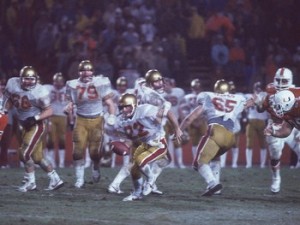
Doug Flutie scrambled out of pressure before launching the game-winning pass against the University of Miami.
Hard to believe that it has been 25 years since Doug Flutie captivated the sports world with a special performance that culminated in one of the most memorable endings in sports history.
In a nationally televised game on CBS the day after Thanksgiving, Flutie solidified his candidacy for the Heisman Trophy by dueling with Bernie Kosar throughout the high-scoring affair.
However, in the final seconds it appeared that Kosar and the defending national champion University of Miami would edge Flutie’s Boston College squad.
With just enough time for one final play and with the ball sitting on Miami’s 48-yard line, Flutie rolled out to his right and launched the ball from his own 36-yard line (64-yards from the end zone) into the waiting arms of receiver Gerard Phelan.
The “Hail Mary” gave BC a shocking 47-45 victory and made Flutie a household name. He went on to receive the 1984 Heisman Trophy.
In honor of the 25th anniversary of this amazing moment in sports, below is a YouTube video recapping the game and Flutie’s amazing pass.
Zach Greinke had the lowest ERA by an American League pitcher since Pedro Martinez in 2000.
This week we look at the transition that has taken place in what voters consider important in selecting the Cy Young Award winner. We also look at a former star athlete who now is really shooting for the stars.
Remember When Wins Mattered For Starting Pitchers?
Zach Greinke’s distinction of sharing the record for the fewest number of wins by a Cy Young winning pitcher (16) didn’t last long as the record is now solely in the hands of Tim Lincecum (15).
In fact, it shows how times have changed to consider that the 31 total victories between the two 2009 Cy Young Award winners equals the total number of wins that Denny McLain registered when winning the American League Cy Young Award in 1968.
It used to be that the number one criteria for a starting pitcher being a serious Cy Young Award candidate was how many victories he recorded in a season. Sure, other factors like strikeouts, ERA and winning percentage have always been important, but the top prize for a pitcher usually was reserved for a hurler who either led the league or came close to leading the league in wins.
The voting for the 2009 Cy Young Awards clearly illustrates that is no longer the case.