Analysis. History. Perspective.

Sports Then and Now


Archive for the ‘Tennis’


Splendor on the Wimbledon Grass: Has Rafael Nadal Surpassed Roger Federer Forever? 3

Posted on June 22, 2010 by JA Allen

Wimbledon 2010: Changing of the Guard even as Federer Lands the Top Seed…
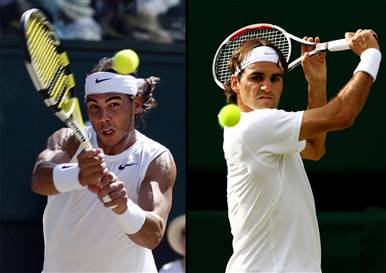
Roger Federer seeded No. 1 at Wimbledon 2010. Rafael Nadal is seeded No. 2 despite being the No. 1 ranked player.

Throughout the wide vista of sporting events, there exists nothing quite as resplendent as Wimbledon draped in quiet dignity as it opens its gates for the fortnight.  The serenity of the grounds contrasts mightily with the sheer aggressive athleticism of its participants. Even grunting and groaning seem out of place on the hallowed green lawns.

The Wimbledon Championships sponsored by the All England Club, have been held since 1877.  It remains the only slam left that offers players a carpet of grass––a step back into the game’s storied past.

Roger Federer serves as Wimbledon’s standard bearer with his all-court game and his delicate movement across the grass.
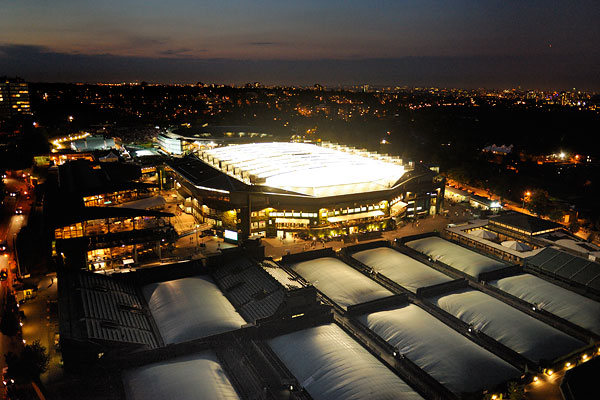
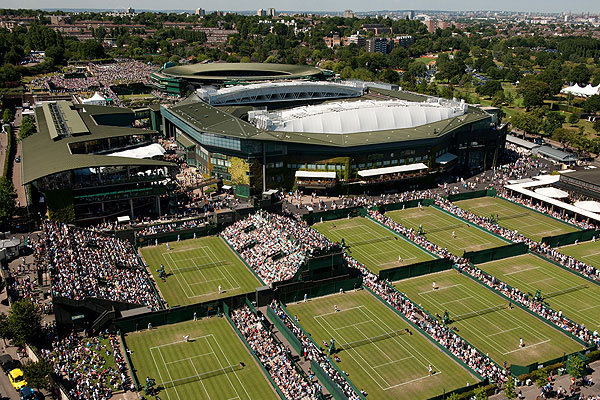
With its new retractable roof, Wimbledon can now host night matches.

As part of its rich tradition, the organizers have given the number one seed to Roger Federer who has played on Centre Court during the finals for the past seven consecutive years.  The number one ranked player in the world, Rafael Nadal, was demoted to the number two seed this year at Wimbledon.  For those of you who think Nadal will not use this as motivation, you do not know the Majorcan very well.
Read the rest of this entry →

Wimbledon 2010: Rafa Rules Men’s Power Rankings 7

Posted on June 20, 2010 by JA Allen

Wimbledon 2010 ready to get underway on Monday June 21.

On Monday, as the sun rises offering the first view of the well-tended lawns at the All-England Club at Wimbledon, tennis aficionados breathe a deep sigh of relief, having survived the dust of the red clay and the sometimes ugly tenor of long grueling matches.

Grass is green, invigorating, inviting brisk movement and light, skipping motions across the lawns.  This is the moment the earth spins properly, as we begin to relax and drink in the panorama of spectacle Wimbledon never fails to offer.

Our pre-Wimbledon Power Rankings fail to reflect the full impact of the move to grass because, as we lament, the grass season is far too short.  It remains a tiny slice out of a season played primarily on artificial, often debilitating hard courts and the soft, forgiving but deadening spirit of the clay.

Those players at the top linger there primarily due to their success on the red clay.  Most hope to repair their strokes and adjust their footwork in time to excel on the grass of Wimbledon, the grandest of the slams.

Read the rest of this entry →

Why Roger Federer’s “Arrogance” Isn’t 15

Posted on June 17, 2010 by Rob York

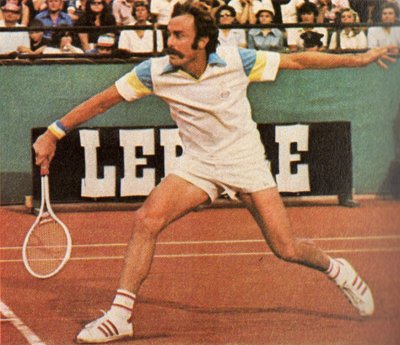
Like most great tennis players, John Newcombe exuded a confidence that bordered on arrogance.

Following a clay court exhibition match against Bjorn Borg in 1978, John Newcombe was asked his opinion on how he would match up with the Swede on grass. He proceeded to explain why he, no matter the surface, enjoyed playing against the man from Stockholm.

“I don’t feel he’s got anything that can really hurt me,” the Australian great said.

At this point in his career, Borg was already a two-time champion at Roland Garros and had also twice lifted the cup at Wimbledon. He was, essentially, the best player in the world. What’s more, Newcombe’s comments came after a 6-2, 6-4 loss to the Swede.

Newcombe, in his next sentence, said that this didn’t mean that he would be able to beat Borg, who played the counterpuncher’s game better than any tennis player ever has. What he meant was that he was he, as an attacking net rusher, would be setting the tone of the point more frequently than the Swede.

Borg might be able to pass him, might be able to lob over his head, might be able to keep chasing balls till Newcombe missed – the Aussie still could and would play the game plan he liked, even in losing.

Still, had there been internet message boards in those days, the “really hurt me” sentence would almost certainly have shown up online with no context attached to show that John Newcombe was either arrogant, disconnected from reality, or both. Tennis has a long history of players who say exactly what they think at the time, and fans online still have yet to grasp that.

In “The String Theory,” David Foster Wallace posed the thesis that tennis players tend to winnow out much of the vagaries of life. They live in a world of nonstop practice, travel, and competition against hundreds of different players, all of whom can consistently drill minute targets on the opposite side of the court while on the dead run.

If they can only hit that bull’s eye 95 times out of a hundred and the other guy can nail it 96 times, they may leave the tournament with empty pockets; they therefor have little time to explore nuances. Wallace arrived at this theory by listening to Michael Joyce, a journeyman player who would never be ranked higher than No. 64, say that an opponent he met in qualifying had a big serve, but “didn’t belong on a pro court.” Read the rest of this entry →

Agassi vs. Becker: The Rivalry That Could’ve Been 1

Posted on June 15, 2010 by Rob York

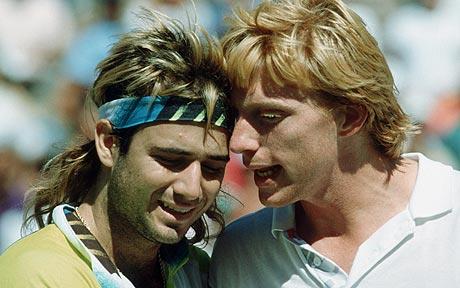
Boris Becker and Andre Agassi have continued their rivalry even after retiring from the game.

If it weren’t for Pete Sampras, Andre Agassi and Boris Becker could’ve had quite the rivalry.

Both men tried to be rivals to Sampras, but rather unsuccessfully. Becker’s game matched up poorly with The Pistol’s, who had all of the German’s strengths plus better movement. The only truly real classic matchup between Becker and Sampras was the 1996 ATP Tour World Championships in Hannover, where Sampras weathered Becker’s hot streak and crowd support before taking a five-set victory.

Agassi’s game, with its immaculate returns, made for a fun contrast with Sampras, but he couldn’t match The Pistol’s dedication and often responded to losses from his compatriot by going into deep dry spells.

Sampras therefore won a combined 32 matches against these two and lost 21. He defeated Becker in all three of their Grand Slam meetings, and Agassi in six of nine. He finished with as many majors as Boom-Boom (6) and Double-A (8) put together.

Agassi and Becker, though, could have provided an ideal contrast to one another as players. Both were men of charisma with loyal fan bases, though Becker’s serve and net-rushing approach was mostly favored by classicists, while Agassi’s enormous groundstrokes and flashy wardrobe appealed to younger fans. Read the rest of this entry →

The Hewitt Dilemma, and Why Grass May Solve It 7

Posted on June 10, 2010 by Rob York

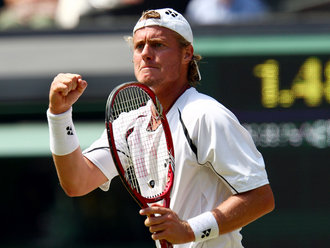
After a strong showing at the 2009 Wimbledon, Lleyton Hewitt will look to repeat his success in 2010.

A good player, or even a great player, can’t avoid facing the game’s best players in the early rounds if he doesn’t improve his ranking.

But how can he improve his ranking if he keeps running into the game’s best players in the early rounds? I call it the Hewitt dilemma.

For Lleyton Hewitt, a winner of both Wimbledon and US Open titles, and the guy who spent all of 2002 at No. 1, the recent majors have been an exercise in frustration. Since 2006 he’s not only been through hip surgery, causing him to miss the 2008 US Open, but he has also faced Rafael Nadal four times at Roland Garros, none of which took place after the round of 16.

Since 2008, he’s also faced Roger Federer at the 2008 Wimbledon, the 2009 US Open, and the 2010 Australian Open. He lost no sets in lead-up to those matches with Federer, but the only set he won against The Great Swiss came in last year’s USO. He surprised more than a few when he took a set from Rafael Nadal in the 2006 RG, but won none from the Spaniard in their subsequent Parisian meetings.

The game has come a long way since the 2001-02 period, when Pete Sampras, Andre Agassi and Patrick Rafter’s careers were winding down, Marat Safin’s was stagnant and those of Federer, Andy Roddick, and Juan Carlos Ferrero had yet to bloom. Read the rest of this entry →

Rafael Nadal Back On Top Of Men’s Tennis Power Rankings 1

Posted on June 09, 2010 by Ronger Fengerer

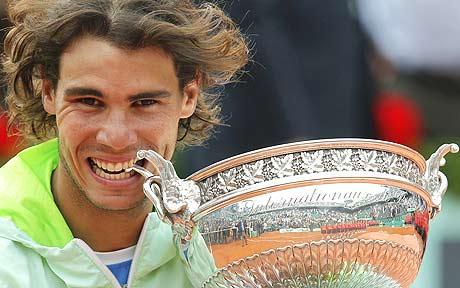
Rafael Nadal is back on top following his fifth French Open title.

“Rafa Nadal best ever on clay…period,” Andy Roddick twittered after the Spaniard completed the unprecedented “Clay Slam” on Sunday, June 6th. I guess most of us would agree. Though we all knew that Rafael Nadal is really good on clay, what he accomplished in this year’s clay-court season was just mind-boggling. The “King of Clay” is once again the King of our power rankings. I doubt anyone needs any convincing to accept that.

Just a small reminder: the grass-court season has already begun. Due to the switch of playing surfaces, the current power rankings might not be a great indicator of form for the next few weeks, especially for those true clay-courters.

The Top 10

1. Rafael Nadal (Last Power Ranking: 1; ATP Ranking: 1)

Last Four Tournaments: Roland Garros [Winner]; Madrid [Winner]; Rome [Winner]; Monte Carlo [Winner]

Power Ranking Points: 2542

2542, that’s a Power Rankings record! Just look at Nadal’s Last Four Tournaments!

Before Madrid Masters began, Nadal was ranked No. 3 in the world, trailing Roger Federer by almost 4000 points. After Madrid, he rose to No. 2, and now he is again No. 1 in the world! I wonder if that is also a record, the fastest from No. 3 to No. 1.

Though some have claimed that this year’s Nadal was not as dominate as in 2008, I have to disagree. In fact I believe Nadal has taken another decisive step towards tennis immortality.

In 2008, Nadal was doing what could be described as “all-out defense/attack,” playing every point as hard as he could. In 2010, he has become smarter and is doing what could be described as “controlled aggression,” playing every point as hard as he needs to. And this can only be achieved if he can play at a higher level than his opponents and he is fully confident in his own game.

With literally “zero” pressure going into Wimbledon, there is a big chance that Nadal could repeat what he was able to accomplish in 2008. And should he pull that off, look for another round of GOAT debate to begin.

Read the rest of this entry →

  • Post Categories


↑ Top