Analysis. History. Perspective.

Sports Then and Now


Archive for the ‘Tennis’


Ken Rosewall: Star of a By-Gone Era 4
Posted on January 11, 2010 by Rob York
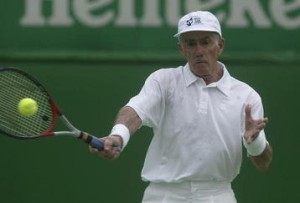
Ken Rosewall is still active as a tennis legend.

Ken Rosewall is still active as a tennis legend.In looking back at the great players of the past, I often can’t help but wonder how they’d perform in the modern game.

It might not have been as lucrative to be a pro tennis player in Ken Rosewall’s day, but there were other advantages.

For though it was a physically demanding sport even then, one didn’t necessarily have to be over six feet tall and ripped. While the modern men’s game has had only two major champions—the single slam winners Michael Chang and Gaston Gaudio—under 5’10”, Rosewall was actually under today’s average international height for males at 5’7″.

And while fitness has long been demanded of its players, Rosewall played in a day when a build like Rafael Nadal’s was unthinkable. Rosewall, actually, would acquire the nickname “Muscles” on the tennis court, but it was ironic moniker: The 145-pound Australian was given the name because muscles were something he didn’t have in abundance.

But Nadal and Rosewall do share kinship in one respect: The close relatives who taught them how to play the game instructed them to do so with their non-dominant arm. Toni Nadal’s decision to teach his nephew to play lefty has proven beneficial, as many a right-handed opponent has struggled to retrieve his high-bouncing shots to their backhands.

It’s a bit harder, though, to see how it benefited Ken Rosewall when his father, an avid player and tennis court owner, insisted that his son play right-handed. Perhaps there was no precedent for left-handed tennis greats in those days; all that is known is that, playing right-handed, Rosewall’s worst shots would be his forehand and serve.a Read the rest of this entry →
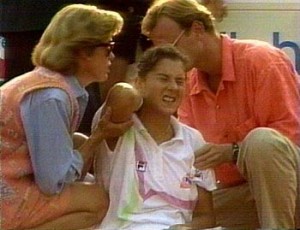
Queens of the Court: Monica Seles, What If? 2

Posted on January 10, 2010 by JA Allen
It is hard not to wonder just how great Monica Seles could have been were it not for the attack in ?????.

It is hard not to wonder just how great Monica Seles could have been were it not for the attack in Hamburg.

Monica Seles, a former world No. 1 tennis player, released her memoir Getting A Grip: On My Body, My Mind, My Self on April 21, 2009.

The autobiography details her bout with depression and her subsequent food addiction after being stabbed in a tennis tournament in Germany.

It also describes dealing with her father’s cancer diagnosis and eventual death, which devastated a daughter who was very close to her dad. Finally it follows her journey back to the game and her aim for a life beyond tennis.

Later on July 11, 2009, Seles was inducted into the International Tennis Hall of Fame, drawing attention to her story by a generation of tennis fans who may have missed her extraordinary rise to the top of the women’s game in the ’90s.

The Early Years

Monica Seles was born in Novi Sad, Yugoslavia on Dec. 2, 1973 but she became a naturalized citizen of the United States in 1994. She started playing tennis when she was five years of age.

Her father, Karoly Seles, coached her and was the one who helped her develop her unique two-handed style with both the forehand and the backhand. He also contrived special moments that made the day-to-day practices fun for the little girl.

She was one of many tennis talents discovered and developed by Nick Bollettieri, training in the Bollettieri Tennis Academy for two years. Read the rest of this entry →

Justine Henin Is Back and Ready to Go 2

Posted on January 05, 2010 by JA Allen
Brisbane International 2010 - Day 2

Justine Henin got her comeback off to a roaring start with a victory over number two seed Nadia Petrova.

As Justine Henin hesitantly watched Roger Federer win his first French Open Crown in 2009 after suffering so many devastating losses on the red clay of Roland Garros, she knew the tiny voice that called to her would never be stilled again.

As Federer collapsed to his knees in an emotional moment at the conclusion of his win over Swede Robin Soderling, Henin took to heart her own series of losses at the only slam that eluded her for so many years, Wimbledon—where Henin had played in her first major final on illustrious Centre Court.

The Belgian had something left to accomplish and it would wait no longer—the void missing needed to be filled.  So Henin picked up her racket for the first time since she had walked away from tennis 20 months ago and began constructing her comeback in the sport that had sustained her when nothing else could fill the loss of her mother and her family.

At age 27, with seven grand slam titles and 41 singles trophies, Henin will make her first appearance at Brisbane where she will face stiff competition against Russian Nadia Petrova seeded No. 2 in this Australian Open Series Tournament.

The No. 1 seed at Brisbane is fellow countrywoman Kim Clijsters who made her way out of retirement last year and astonished the world by winning the 2009 U.S. Open.  Seeing Clijsters make good had to give Henin confidence that it was possible to come back strong—maybe even stronger than when she left. Read the rest of this entry →

Repeating History: What Sampras-Rafter Can Teach Us About Nadal-Soderling 5

Posted on January 04, 2010 by Rob York
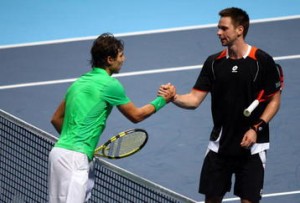
Could Rafael Nadal and Robin Soderling develop the next great rivalry in tennis?

Could Rafael Nadal and Robin Soderling develop the next great rivalry in tennis?

In 1997 Patrick Rafter won his first major at the US Open, thanks to his agile movement, big-kicking serve and unparalleled net coverage. Though this put him exactly nine majors behind Pete Sampras at that point in their careers, it was easy to begin wondering how the two would match up in future encounters.

Still, the two weren’t truly rivals yet; Sampras was 5-1 against the Australian at that point and would add three more lopsided victories over Rafter to his tally that fall. Plus, with the bulk of his accomplishments and the fact that he had a commanding lead in the race for No. 1, few could seriously claim that the two were players of equal stature.

To become a rival to Sampras, Rafter would have to beat the American, and take something he wanted.

That would come in 1998, when the Australian rallied from down a set to top Sampras at the Cincinnati Masters tourney. Sampras had already won Wimbledon that year, and Rafter’s successes for 1998 were just beginning; still, Sampras hungered for the points that event would bring him. He was pursuing the year-end ranking for the sixth consecutive year – a record – and Marcelo Rios was hot on his heels. Read the rest of this entry →

Queens of the Court: Martina Navratilova, Lifting The Game To New Heights 12

Posted on January 04, 2010 by Marianne Bevis
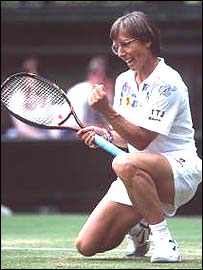
Martina Navratilova dominated women's tennis for more than a decade.

Martina Navratilova dominated women's tennis for more than a decade.

Her achievements on the tennis court are almost without parallel.

Her energy in supporting the rights of others has been a constant.

Her passion for the sport that she says “gave her a soul” is unquestioned.

Yet it is one particular interview, following one particularly unlikely event in this tennis icon’s life, that throws as much light on her character as any of those achievements.

Martina Navratilova was a surprise participant, and a surprisingly popular finalist, in the 2008 television show “I’m a Celebrity…Get Me Out Of Here.” And in an interview for the U.K.’s revered Times newspaper, she admitted it was simply the challenge that made her sign up.

“I want challenges, whether cerebral or physical…If you never push yourself, you won’t know what your point of failure is. People always said I was so competitive. Not with other people, with myself.”

This gets to the heart of what made Navratilova one of the most successful women ever to pick up a tennis racket: the need to prove to both herself and the world what was possible.

However, there is a second quote that gets to the heart of what makes her such an enduring, respected, and important woman beyond the tennis court.

“If I feel strongly, I say it. I know I can do more good by being vocal than by staying quiet. I’d have a whole lot more money if I lied, but I wouldn’t have enjoyed spending it.”

This is the story of a courageous, feisty, and generous woman who also happened to challenge political repression and personal prejudice on her way to becoming one of the world’s greatest living athletes.

“You can’t live in the past.”

Navratilova was born in October 1956, in Prague, Czechoslovakia, but her ski-instructor father and her mother divorced when she was still very young.

Tennis ran in her family. Her grandmother had been an international player and, when her mother remarried in 1962, her stepfather became her coach.

By the age of eight, Navratilova reached the semifinals of her first tournament, and her talent began to attract the attention of the Czech authorities.

In 1972, age 15, Navratilova won the Czech national tennis championships. The next year, she reached the quarterfinals of the French Open and the third round of Wimbledon. Read the rest of this entry →

Reaching for the Top: Novak Djokovic Looks For Repeat Down Under 4

Posted on January 02, 2010 by JA Allen

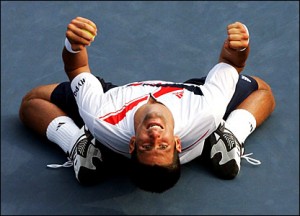
Novak Djokovic will look to return to the form that helped him win the 2008 Australian Open.

Novak Djokovic will look to return to the form that helped him win the 2008 Australian Open.

If winning isn’t everything, why do they keep score? ~Vince Lombardi

If you pay attention to the rhetoric emanating from the tennis world and note all the speculation about the upcoming “season”, you will hear endless debates about which player will survive the ATP or WTA 2010 scheduled obstacle course to wear the No. 1 mantle.

The irony is, of course, that even after a whole year of competition in 2009, when Roger Federer emerging with the No. 1 ranking, there is no consensus that he is the worthy recipient of that well-earned entitlement.

Consider Dinara Safina’s reign at No. 1, for example.  Regardless of the stats pronouncing the unequivocal bottom line, the debate continues to rage about who is “the best”.  Is it safe to assume that “No. 1” and “best” even equivalent terms?

Who should be No. 1 appears to be quite subjective. Is it a mark of greatness that you can hold the No. 1 ranking even if you have never won a “major”—like Dinara Safina, on the women’s side?  Winning isn’t enough apparently—you have to win majors.

On the men’s side, there are few besides Federer and Rafael Nadal who have accomplished that.  Then how many majors are enough to appease the perfectionists amongst us?  What criteria should be examined to determine the designation of No. 1?

Read the rest of this entry →

  • Post Categories


↑ Top