Analysis. History. Perspective.

Sports Then and Now


What Would Clarke Hinkle and Bronko Nagurski Think of the Modern NFL? 4
Posted on April 10, 2011 by Dean Hybl

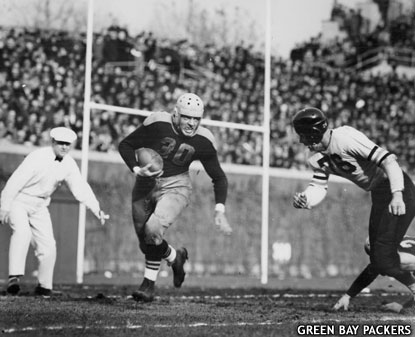
Clarke Hinkle played in an era before players wore facemasks and other protective padding.

If he were still alive today, you can bet that former NFL running back and Pro Football Hall of Fame member Clarke Hinkle would have some pretty terse things to say to both the players and owners in the current labor mess. Though Hinkle, who would have celebrated his 99th birthday on April 10th, passed away in 1988, words he wrote to me several years prior to his death are a great reminder of how different the NFL of today is from when he helped make the game popular in the 1930s.

As a teenager in the early 1980s, I sent letters to many former professional athletes expressing how much I thought of what they had done and asking for an autograph. Because this was in the days before autographs became such a big and lucrative business, I actually received many cards, pictures and letters back from former greats ranging from Otto Graham, Doak Walker and Bart Starr to Johnny Bench, Sparky Anderson and Happy Chandler.

In each letter I typically included a couple paragraphs talking about their career or something else that I thought was interesting.

In writing to Clarke Hinkle, I mentioned how I thought it was interesting that he had once been the NFL’s all-time rushing leader with 3,850 career yards. In fact, he held that honor from the time he retired in 1941 until being passed by Steve Van Buren in 1949. At the time I was writing to him, the record was held by Jim Brown with 12,312 yards and Walter Payton and Franco Harris were in competition to eclipse that total.

Usually what I received back from the athletes was a signed picture and occasionally a brief note or some other personal memorabilia (like a post card).

To my surprise, from Hinkle in addition to an autographed card I received a two page hand written letter in which he spent most of the time talking about how easy pro football players of the current era have it compared to players from his day. He said that the rushing records would be much less if those players had to play both ways (Hinkle played tailback and linebacker) and deal with players like Bronko Nagurski. Read the rest of this entry →
Replacing the No Football League 1

Posted on February 28, 2011 by John Wingspread Howell

I don’t get it. How could there not be a NFL season this year? Last time there was a strike the league used replacement players and a handful of scabs. Why can’t they do that again?

There is something appealing about the use of replacement players every so many years. For once, no one knows how to handicap any of the teams. The whole standings are pretty much up for grabs. Any team can beat any other team. Worst to first is a definite possibility.

Oh, wait! Any team can beat any other team when the regular players play. Worst to first is a definite possibility then, and has happened frequently in recent years. But even more so, I suppose, with a whole roster of no-names.

On the other hand, none of the players would be under contract so what’s to stop them from organizing their own new league? Wouldn’t that be interesting? The NFL with its replacements would suddenly be the minors, while the new PFL (Players Football League) would be the real thing.

Or what’s to stop the UFL or CFL from signing a bunch of the NFL’s best and suddenly become the gold standard, again relegating the NFL to minor league status.

But here’s my proposal. Let every city field a team in a new league to be formed. Call it the Cities Football League or the Peoples Football League. Teams would be owned by the cities they represent in a stock arrangement like Green Bay, so no franchise would ever be bought out and moved, and all the profits would go back into team and league operations, including player salaries. Read the rest of this entry →

Sports Economics For Dummies: How To Split $9 Billion Dollars 3

Posted on February 18, 2011 by Dean Hybl

The announcement Thursday that the NFL and its Players Association have agreed to mediation is a sign of hope, but unless there is a major breakthrough in the next two weeks, it still looks like the NFL is headed for its first major labor disruption in 24 years. Given that residents across the United States are still feeling the pinch from the most pronounced economic recession since the Great Depression, don’t expect either group to receive much sympathy as they struggle to split more than $9 billion in annual revenue.

With the revenue and popularity of the NFL at an all-time high, it seems like a strange time for a labor dispute, but both sides seem more interested in annihilating the other side than reaching a compromise that would benefit all parties.

The owners, who opted out of the previous collective bargaining agreement two years early, are focused on receiving additional money off the top to cover expenses that they say are critical to growing the league and generating new revenue. Currently, the first billion dollars of revenue goes directly to the owners with the players then receiving roughly 60 percent of all remaining revenue.

In 2010 the result of this split was that the owners received $4.75 billion with the players earning $4.65 billion. All in all seems like a pretty good return for both sides. However, since the owners have never been forthcoming about their total expenses, it is difficult to tell if the owners are making a great profit or barely breaking even.

The owners have proposed taking an additional billion dollars off the top before any revenue splitting occurs. Conversely, the players are proposing that all revenue be split 50-50.

There is no question that escalating costs for stadiums, promotions and other elements of operating the business have increased over the last decade. Though revenues have continued to increase during the economic recession, the cost to generate these revenues has also increased.

In most businesses, he who takes the greatest risk typically receives the greatest rewards. However, professional football is somewhat different than the norm because while the owners are the ones taking the financial risks, it is the players who are taking the physical risks every Sunday.

With an average career length of barely four years and the very real risk of suffering injuries that will have an impact for years to follow, NFL players are very much focused on keeping as much revenue as possible.

Unlike the players in baseball, basketball and hockey, NFL players do not have guaranteed contracts, so their contracts often include large up-front signing bonuses. The owners would like to make it easier to recoup this bonus money when players break the law or violate the personal conduct policy, but the players are hesitant because up-front dollars are the only guaranteed money a player receives. Read the rest of this entry →

What Blunder Will The Pro Football Hall of Fame Voters Make This Time? 2

Posted on February 04, 2011 by Dean Hybl

"Prime Time" should be an easy pick for the Hall of Fame voters.

Predicting which team will win the Super Bowl on Sunday is an iffy proposition, but one sure bet this weekend is that the Pro Football Hall of Fame selection committee will do something surprising when making their picks for the 2011 Hall of Fame Class.

There are many wonderful things about the NFL, but the selection process for the Pro Football Hall of Fame is not one of them.

Over the last two years I have written several articles outlining how I think the voters have missed the boat in many of their choices, or non-choices, and now have created a back-log of qualified candidates who are not in the Hall of Fame and probably will not gain entry for years to come, if ever.

You can read my list from last summer of the 25 players I think are most deserving of Hall of Fame selection. This list does not include first-year eligible players, but seven of the 17 Hall of Fame finalists for this year are included on my top 25.

When the committee meets tomorrow, if they do nothing else I hope they select at least six members to the 2011 Hall of Fame class and I’m okay if they make it seven.

Last year marked the first time since 2001 that the Hall of Fame voters selected the maximum number of seven inductees. Part of the reason for the glut of deserving players is that the voters selected only four players in both 2004 and 2005. Considering that 13 players and coaches who have entered the Hall of Fame in subsequent years were eligible during those years, it doesn’t make any sense to me why those classes were so small. Read the rest of this entry →

Mark Herzlich Is What Athletics Should Be About 4

Posted on January 30, 2011 by Ray Thompson

Mark Herzlich at the 2011 Senior Bowl.

If you pay attention to College sports, then you would be hard pressed to remember a more turbulent year than 2010.

Cam Newton’s recruiting scandal was as big of a story in 2010 as his play on the field, in which he led the University of Auburn to the National Championship.

Ohio State’s scandal where five starters were involved in trading autographs for free tattoos resulting in a 5 game suspension that will begin with the first 5 games of the 2011 season.

Reggie Bush returned the Heisman for receiving improper benefits while he was a player at USC dominated the college sports headlines in the first half of 2010.

Meet Mark Herzlich, linebacker for Boston College, and the definition of what a College Athlete should represent.

At a time when many top tier college athletes are mired in recruiting scandals, Mark Herzlich stands out and not just for the reason you may think. Mark Herzlich is not just a top tier linebacker many experts feel will go in the early rounds of the NFL draft, but Mark is also a cancer survivor and his story has been an inspiration to many.

Mark was recruited by several top programs, including Johns Hopkins University to play Lacrosse, which Mark also excelled at while in High School. Lucky for the maroon and gold, after originally committed to play football for the University of Virginia, Mark later changed his mind and decided on Boston College.

As a freshman at Boston College, Mark made an immediate impact, starting all 13 games in 2006. In 2007, Mark finished second on the team in tackles, leading Boston College to the Champs Sports Bowl on defense. By the end of the 2008 season, Mark’s Junior year, Mark became the team leader in tackles, won the ACC defensive player of the year, was listed on many all American teams and was a finalist for the Butkus award, the award given for the nation’s top college linebacker. Mark had become one of the nation’s elite line backers, and was the top linebacker in the ACC, a BCS conference. The future was bright for Mark as he was heading into the end of his Junior year preparing for a much anticipated Senior campaign that would no doubt propel him into the first round of the NFL draft.

Read the rest of this entry →

The Seattle Seahawks Should Be Embarrassed to be in the Playoffs 1

Posted on January 07, 2011 by Thomas Rooney

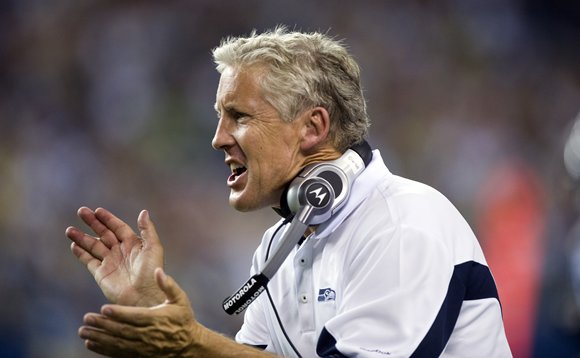
In his first season leading the Seahawks, Pete Carroll guided the team to the playoffs, but not to a winning record.

The NFL is a competition that can be proud of the fact that it is competitive and consistently exciting, but there is one thing that it cannot boast at present and that is a strong NFC West.

With the Seattle Seahawks earning a spot in the playoffs despite the fact that they have endured a hugely disappointing season, it is surely to their utter embarrassment that they have made the play-offs with a 7-9 record and have since been reduced to the status of total outsiders in the battle to win the Super Bowl.

However, whilst this may well be the case, the fact is that once you reach the play-offs anything can, and possibly will, happen. Add into this equation the change in the NFL playoff overtime rules, which guarantee both sides the chance to score with their possession, and you start to think that it may be possible to win if a team can just make it to overtime. Read the rest of this entry →

  • Post Categories


↑ Top