Posted on
October 29, 2013 by
Daniel Lofthouse
 Every good athlete knows the benefit of a sports massage, and it is often a factor in their success. Some elite athletes even have sports massage therapists who travel with them to help them improve performance, prevent injury and feel better as they are exercising or playing their sport.
Ancient Massage
Massage generally has been in existence for thousands of years. In China, there are documents claiming that massage was used 8,000 years BC for ailments. The ancient Persians and Indians were also known for healing with massage, and the Ancient Romans were treated to a massage before and after Olympic events. Knowledge of massage continued to progress until the Chinese created the first schools of massage in 100 AD.
Late 1800s
There is debate about who introduced the theories and techniques of medical massage to the scientific community. Some attribute them to Johann Mezger, and others to Pehn Ling. However, terms such as effleurage (gliding), petrissage (kneading), tapotement (pounding), friction (rubbing) and vibration (shaking) were used at this time, and they continue to be used to this day.
The Finnish School of Massage officially laid out sports massage methods in 1900. Read the rest of this entry →
Tags: Sports Massage
Category
Sports Fitness
Posted on
October 28, 2013 by
Daniel Lofthouse
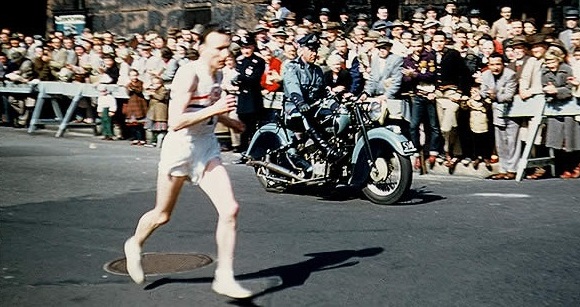
Jim Peters set the world marathon record four times between 1952 and 1954.
The first modern marathons were held at the 1896 Summer Olympics, and were won by two Greek runners – Kharilaos Vasilakos and Ioannis Lavrentis. In the ten years that followed, their times of 3:18:00 and 3:11:27 (respectively) would be beaten by runners from Britain, Japan, and America – the last of which was run by Johnny Hayes at the 1908 Summer Olympics in what is considered to be the first marathon over a now official distance of 42.195 km.
Top Runners from Around the World
From 1908 onwards, the field of marathon running began to be dominated by an elite set of countries who regularly produced high performing marathon standard athletes.
In the men’s races, Sweden, Japan, American and the UK were regular contenders for the top spot, with many of their runners continuing to break records. A roster of familiar faces began to creep in: Son Kitei of Japan, Jim Peters of the UK (who broke the world record four times between 1952 and 1954), and Derek Clayton of Australia, who broke his first record in 1967 and followed up with an encore in 1969. It wasn’t until 2002, however, that the title of ‘World’s Best’ was introduced and presented for the very first time to American runner Khalid Khannouchi for his time of 2:05:37.8. Read the rest of this entry →
Category
General, Sports Fitness, Sports History, Track & Field
Posted on
September 30, 2013 by
Daniel Lofthouse

Abebe Bikila was known for running marathons barefoot, including his victory in the 1960 Olympics.
Of all the sports and exercises in the history of the world, the most fundamental and common is undoubtedly running. The prizes in the very first footraces were the largest. In the first footraces ever it was a race to elude predators. It is easy to visualize early man going into a sprint to reach the safety of a cave or fire while pursued by a sabre tooth tiger or equally ferocious animal. While hard to call it a sport with those stakes, it is none the less undoubtedly the origin of the sport of running.
As the centuries went past the first Marathon was thought to be run around 500 BC and the survival skill of running evolved into a sport. Since those earliest days the question of what is the best footgear to run in has been asked, answered, and refined hundreds of times. The sandals laced up around the ankles protected the feet from rough terrain but the earliest Olympiads foreswore those often times for bare feet to save those few ounces in weight. That is not dissimilar to the last 100 years where shedding of weight while preserving protection and support has become a billion dollar industry highlighted by the likes of Nike, Adidas, and New Balance among many others.
The technology and science has gone from the basics of protecting the soles of feet and proving traction, to increasing cushioning and comfort, to literally having loaded springs that artificially increase stride and speed. Throughout all this advancement in technology, there were still famous runners like Abebe Bikila that won a gold medal in the 1960 Olympic Games while running the marathon barefooted. Read the rest of this entry →
Tags: Abebe Bikilabarefoot runningfive finger running shoesmarathons
Category
General, Sports Fitness, Summer Olympics
Posted on
August 28, 2013 by
Daniel Lofthouse

Steve Reeves (far left) helped elevate interest in bodybuilding.
The roots of bodybuilding can be traced back as far as ancient Greece. But in those ancient times, it was not so much a tool for personal body modification as it was a method of training for sports that the ancient Greeks participated in. Since then of course, many have chosen bodybuilding as a means of attempting to achieve some sort of aesthetic muscular perfection. Some of these fitness mad individuals have now become household names.
Steve Reeves
In the late 1940s and 1950s, Hollywood heart throb Steve Reeves was largely responsible for bringing bodybuilding into the public consciousness in a big way. Prior to Reeves, bodybuilding was a relatively unknown sport and it was through Reeves’ series of movie roles that bodybuilding first gained recognition and interest from the general public. Considered by many now to be the Arnold Schwarzenegger of his era, Reeves won the 1947 Mr. America, the 1948 Mr. World and the 1950 Mr. Universe, putting him amongst the most prolific bodybuilders of his generation.
Arnold Schwarzenegger
Undoubtedly the most famous of all professional bodybuilders, Arnold Schwarzenegger burst onto the international bodybuilding scene in 1966, known then as “The Austrian Oak”. At the age of only 23, Schwarzenegger became the youngest ever man to win the Mr. Olympia contest in 1970, a title he would hold for six consecutive years. On the brink of retirement from bodybuilding, Schwarzenegger was convinced by filmmakers George Butler and Robert Fiore to compete in Mr. Olympia one more time, an event which was captured in their documentary Pumping Iron. The film drew interest from Hollywood, and catapulted Schwarzenegger into international stardom.
Read the rest of this entry →
Tags: Arnold SchwarzeneggerBodybuildingRonnie ColemanSteve Reeves
Category
General, Sports Fitness
Posted on
August 08, 2013 by
Daniel Lofthouse

Chrissie Wellington has developed into a record-setting triathlete.
In the past, feats including marathon and triathlon were accolades only a few could boast. Only the elite were understood to have the natural capability and mental strength for such challenges. Today, this notion is all but eroded. Today, ‘ordinary’ athletes train around family and professional commitments to not only complete, but to race in prestigious events. Regular people have a thirst for ambition and continue to push personal and industry boundaries.
The Ironman Triathlon, for example, is a pursuit that is growing in availability, and popularity, against all odds. The 2.4-mile swim, followed by 112-mile bike ride culminating in a marathon distance run is a daunting prospect for even the fittest of athletes. In its infancy, the event wasn’t wholly competitive, more a quest for survival. The achievement was simply to finish within the stated time. It was the intense rivalry between Dave Scott and Mark Allen that catapulted the legendary Kona Ironman from test to race, in 1989.
Another personality making Ironman history is world- champion, Chrissie Wellington, who is the only triathlete- male or female- to have won the Ironman TriathlonWorld Championship less than a year after turning professional. Formerly a marathon runner with little background in endurance, Chrissie Welllington went on too lower the world record every time she raced the triathlon Challenge Roth in Germany. Read the rest of this entry →
Tags: Chrissie WellingtonIronman Triathlon
Category
Sports Fitness
Posted on
August 08, 2013 by
Daniel Lofthouse

Events like the Tough Mudder help fitness buffs get back to the basics.
Fitness technology is unarguably developing at an exciting pace: Mobile phones, such as the Samsung S4 are able to provide a holistic record of your sleeping patterns, daily exercise output, heart rate and more. Garmin watches can track how fast and how far you run. Of course, the gym remains the place that harnesses the latest of technology all under one roof.
Yet, alongside the penchant for virtual personal trainers and hyperreal fabrics, there exists a demand for more classic, tried and tested approaches to exercise. This might be a reflection of the fact that technology, with its obvious advantages, remains potentially unreliable. Moreover, the latest technology advancements can be alienating, or simply distracting from the enjoyment of recreational exercise. The appeal of this informed ‘back to basics’ approach is evident in the continual revival of fitness classes. Classes such as circuit training, spinning, bootcamp and dance have increased in popularity due to a demand for creative, rather than innovative, exercise options. Similarly, traditional endurance events, such as the Tough Mudder challenge reflect this desire for fuss- free programs that guarantee results. Read the rest of this entry →
Tags: Sports FitnessTough Mudder
Category
Sports Fitness
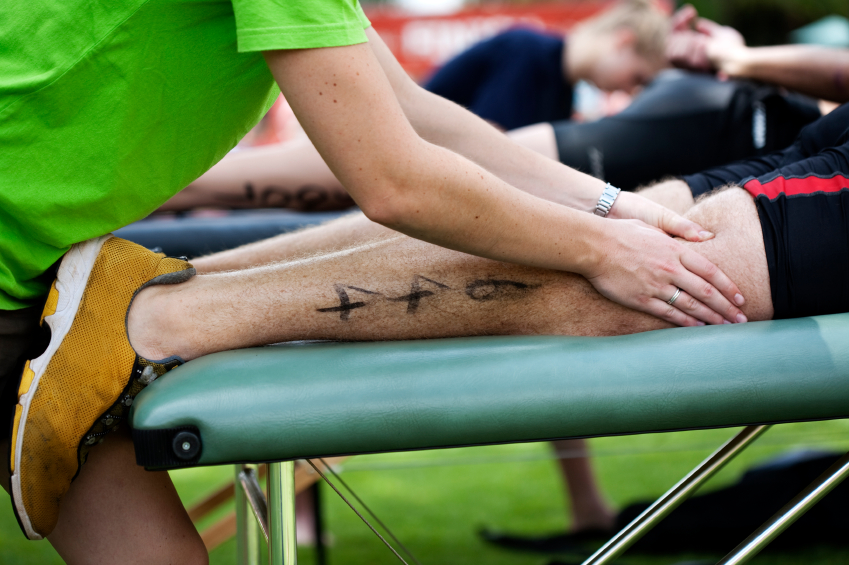 Every good athlete knows the benefit of a sports massage, and it is often a factor in their success. Some elite athletes even have sports massage therapists who travel with them to help them improve performance, prevent injury and feel better as they are exercising or playing their sport.