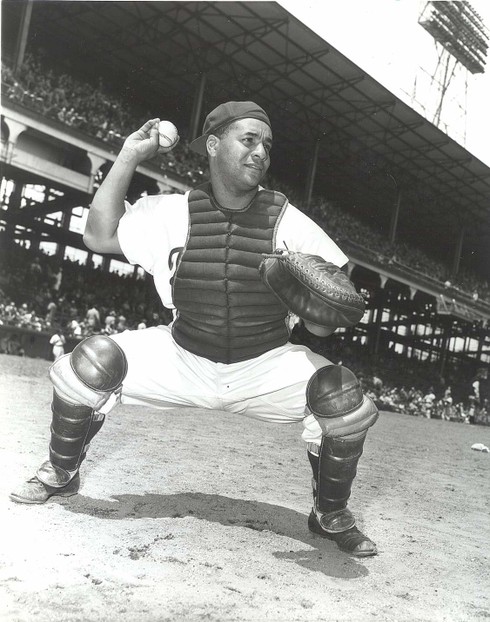
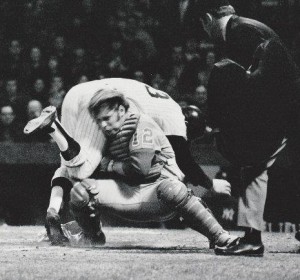
The Vintage Athlete of the Month for August proved that race didn’t matter as the first great African American catcher in Major League Baseball while winning three Most Valuable Player Awards during a decade with the Brooklyn Dodgers.
Roy Campanella joined the Dodgers as a 26-year-old rookie in 1948 and quickly emerged as a key reason the Dodgers won the NL Pennant five times over the next nine seasons. Read the rest of this entry →
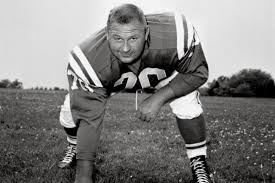
Art Donovan was one of the great characters in NFL history.
The sports world lost one of the great characters of all-time with the passing on Sunday of football Hall of Fame defensive lineman Art Donovan at the age of 89. Not only was Donovan a Hall of Fame football player, but he was also an American Hero as he served with distinction during World War II.
The son of Hall of Fame boxing referee Art Donovan Sr., Art Jr. originally attended Notre Dame for one semester before leaving school in 1942 to enlist in the Marines. Stationed in the Pacific, he served as an anti-aircraft gunner on the USS San Jacinto during the assault on Leyte in the Philippines.
He later volunteered for the Fleet Marine Force, which landed him in the middle of combat on Okinawa. His citations, which included the Asiatic Pacific Area Ribbon and the Philippine Liberation Ribbon, are a major reason he was the first pro football player selected for the U.S. Marine Corps Sports Hall of Fame.
After the war, Donovan played college football at Boston College before being drafted by the New York Giants as the 204th pick of the 1947 NFL Draft.
He did not actually make his NFL debut until 1950 playing for the original Baltimore Colts. After the team, which also included future Hall of Fame quarterback Y.A. Title folded, he then spent the next two seasons playing for the New York Yanks and the Dallas Texans. As luck would have it, both of those teams also failed and in 1953 he returned to Baltimore with the reincarnated Baltimore Colts.
With the new Colts, Donovan emerged as one of the top defensive linemen in the league. He was a Pro Bowl selection in 1953 and from 1954-57 was a first team All-Pro each season. He was a member of the championship teams for the Colts in 1958 and 1959.
Donovan remained with the Colts through the 1961 season and was elected to the Pro Football Hall of Fame in 1968.
On the field Donovan was just another faceless lineman performing the grunt work in the trenches. But after his retirement, Donovan was anything but quiet and anonymous. His book Fatso was a best seller and he made many appearances on late night television with Johnny Carson and David Letterman. He was also featured one year in ESPN football ads and was prominent in some great NFL Films programs that remembered football in the 1950s and 1960s.
Below are a few of the great video clips featuring this American original. Enjoy!
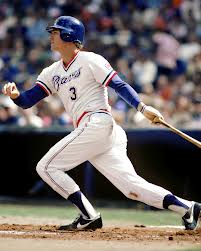
With 398 home runs and two MVP Awards, would Dale Murphy had made the Hall of Fame if it hadn’t been for the Steroid era?
In a year in which baseball’s all-time leader in home runs, a member of the prestigious 3,000 hit club and the winner of 354 games on the mound are all eligible for the Baseball Hall of Fame for the first time, not a single modern-era player will receive baseball’s greatest honor during the annual induction ceremony on Sunday.
To honor this auspicious occasion, Sports Then and Now is recognizing five baseball players that we believe have legitimate claims to being in the Hall of Fame and who very likely might have received the “call to the Hall” years ago had not a generation of players totally changed the perception of offensive production.
When Dale Murphy retired from baseball in 1993 the PED era in baseball was just getting started. By the time he became eligible for the HOF ballot in 1999, Mark McGwire and Sammy Sosa had made a mockery of the single season home run record and Murphy’s career total of 398 home runs and top season of 44 dingers were no longer particularly impressive.
As a result, Murphy was included on 19.3% of the ballots in his first year and 23.2% the next year, but as the home run totals of current players escalated, his vote totals steadily declined. He was included on only 8.5% of ballots by 2004 and never legitimately had a chance for induction. His run through the HOF gauntlet mercifully ended earlier this year as he received 18.1% of the votes (75% needed for induction) in his final year on the ballot. Read the rest of this entry →
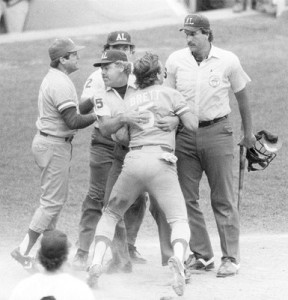
After having his home run reversed, George Brett had to be physically restrained from umpire Tim McClelland.
It is hard to believe that it was 30 years ago, July 24, 1983, when New York Yankees manager Billy Martin set off “Volcano Brett” after Kansas City Royals star George Brett launched what appeared to be a two-run home run in the top of the ninth inning of the final game of a four-game series between the two teams at Yankee Stadium.
The scene of a totally unhinged Brett erupting out of the dugout and having to be restrained from home plate umpire Tim McClelland by the other umpires and his teammates is a familiar one that has been replayed extensively over the last three decades.
However, the entire incident is an amazingly interesting time capsule for baseball from an era before steroids, corked bats and other unlawful tricks to get an edge completely changed the game of baseball.
In re-watching the video, it is almost comical to think anyone would take Martin’s argument seriously and legitimately consider that having a little pine tar more than 18 inches up the handle of the bat would play any role in Brett’s home run off Goose Gossage.
However, after Martin spent time pointing out the indiscretion to McClelland and the other umpires, they actually measured the bat against the plate and then McClelland famously signaled that Brett was out, thus launching one of the most famous tirades in baseball history.
Of course while the Yankees technically “won” the game on that afternoon with Brett being the third out, the victory was overruled by American League President Lee MacPhail. He ordered the game to continue following the Brett home run with the Royals now leading 5-4. Read the rest of this entry →
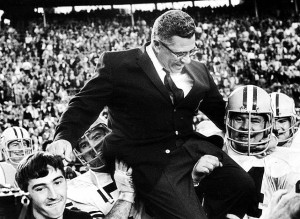
Though he was only a head coach for a decade, many consider Vince Lombardi the greatest coach in NFL history.
There are plenty of candidates for the title of best football coach ever, but there can only ever be one winner; by common consent, that is Vince Lombardi.
He was a tough taskmaster who thrived on hard work, had exacting standards, and expected nothing less than 100 percent from his players. He coached Green Bay to five championships in his nine seasons at the helm and, in a period that saw the Packers take the first two Super Bowls, the ultimate accolade from the NFL, the World Champions Trophy now bears his name.
Lombardi started his football on the field and was a formidable player on the offensive line at Fordham University but coaching proved his true metier, as modern fans of live football commentary will attest. After working as an assistant at Fordham, he joined the staff of the legendary Red Blaik at Army in 1949.
His professional coaching career started at the New York Giants, alongside another legendary coach in Tom Landry, with Jim Lee Howell as the head; that triumvirate coached the Giants to the 1956 NFL championship.
It was in Green Bay that he found his true calling though, and with a team that had not finished with a winning record since 1947. The Packers hired Lombardi as head coach and general manager in January 1959, after Iowa coach, Forrest Evashevski, turned it down. Read the rest of this entry →
The Sports Then and Now Vintage Athlete of the Month was an American League All-Star in 1974 and a solid catcher during his 11 year Major League career.
Ed Herrmann had baseball in his blood as his grandfather, Marty Herrmann, did not allow a run or hit during his one inning of action as a major league pitcher for the Brooklyn Robins in 1918.
Fortunately for Ed, his major league career lasted much longer than that of his grandfather.
After appearing in two major league games (and going 2 for 3) for the Chicago White Sox during the 1967 season, Herrmann returned to the majors for good in 1969 and soon was entrenched as the regular catcher for the White Sox. Read the rest of this entry →