Imagine if one of the most iconic athletes of the current
era suddenly retired, announced he had an incurable disease and within two
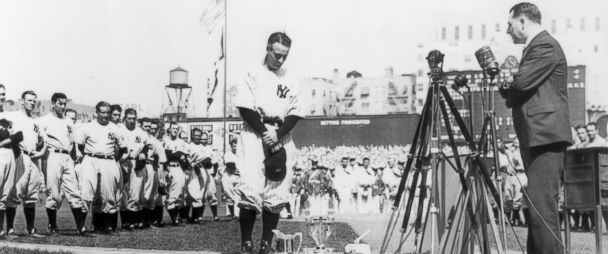
years was dead. That is exactly what happened in 1939 when iconic New York Yankees
star Lou Gehrig pulled himself out of the lineup after 2,130 consecutive games
and then 80 years ago, on July 4, 1939, said goodbye to New York fans with his
famous “luckiest man on the face of the earth” speech.
For 13 years, Gehrig was baseball’s most durable player as
he famously was in the lineup every day. But durability wasn’t his only
strength, he was also the best first baseman of his generation and was a
run-producing machine.
Only Gehrig could push the Sultan of Swat, Babe Ruth, into
the number three spot in the batting order. He drove in 140 or more runs nine
times during his career, including 185 RBI during the 1931 season. In 1934 he
claimed the triple crown as he hit .363 with 49 home runs and 166 RBI.
Johnny Depp has been among the world’s most famous actors for decades. He started off as an anonymous guitarist and worked his way up to some of Hollywood’s most successful blockbusters. He is not just a handsome guy that has never left his grunge phase but an actual artist who has managed to prove his talent multiple times.
Just remember a vast number of Tim Burton’s movies he has starred in. Fun fact: he was once asked during an interview if he watched his own movies. When he said no, the interviewer responded: “You must have seen few Burton’s movies.”
If you are a fan of Johnny’s the way I am, this article will amuse you as much as baccarat and slot machines amuse gamblers. In the following lines, you will see a list of the best movies he has ever starred in, according to, well, me (spoiler alert: “The Pirates of the Caribbean” have not made the final cut).
10. Finding Neverland
This drama movie from 2004 tells a story of a successful playwright James M. Barrie (Johnny Depp) and how the story of Peter Pan came to be. The movie is situated in the 20th century London, where Barrie meets a single mother (Kate Winslet) and her four sons. He quickly befriends them and starts entertaining the boys by telling them stories and feeding their imagination. He draws inspiration for his latest play from the family and finally creates Peter Pan.
In some countries football is more than just a game; it is a
national obsession that drives people crazy in a good way. Did you notice that
during the football season, your colleagues and friends speak only about the
game? If you don’t want to feel left out, learn important football terms, slang
and cliches. The next FIFA World Cup will be held in Qatar in 2022, so it is
better to start preparing for its ‘madness’ today.
Tiki-Taka
Tiki-Taka is Barcelona’s style of playing football. It was
implemented by Johan Cruyff in the early 1990s. Basically, it means ‘taking
quick, light steps.’ This style implies short passing. Also, team players are
not positioned in a traditional formation. On the contrary, they are free to
move and pass the ball. In 2009, it helped FC Barcelona to win six trophies.
A fox in the box
It is an English idiom that is used to describe deadly
strikers who are extremely good in the penalty area. For instance, Filippo
Inzaghi, Italian professional footballer is an excellent example of ‘the fox in
the box. ’ He retired with over 300 career goals and deserved the title of a ‘
killer striker.’
Major
sporting events draw hundreds of thousands of fans every year to watch their
favorite teams compete for the title. With so many people in one place, how can
event organizers make sure these events are safe and secure so everyone can
enjoy the game?
It Depends on Many Different Factors
The
security for your local high school football team is going to be vastly
different from the kind of security needed to keep a million people safe during
the Super Bowl. It also depends on the venue, the estimated number of people
that will be attending, and the popularity of the teams.
Planning
security for the most significant events — such as the Super Bowl — doesn’t
happen overnight. The 53rd Super Bowl, which took place in 2018, took two years to
plan and
nearly 40 different local, state and federal agencies worked together to make
sure the event was all about the game, and no one had to worry about their
safety while attending.
Concern About Terrorist Threats
In
today’s modern world, terrorist threats are a real concern when you get
thousands of people together in one place. In response, athletic venues have
spent more than $2
billion a year
to improve security. It’s not foolproof, yet — in 2017, a bomber detonated a
bomb in the packed Manchester Arena by hiding it in his backpack. This attack killed 23
people and
injured hundreds more.
The
goal of this seemingly excessive spending is to enable these venues to create a
culture of security and make sure everyone stays focused on keeping patrons
safe while they enjoy the game.
It’s Not All In-House Security
While
each venue will have its own in-house security, that isn’t always enough for
significant events — especially if the stands and surrounding area are packed
with fans. For the 53rd Super Bowl in Atlanta, in addition to venue security,
the city of Atlanta brought in more than 5,000
law enforcement officers, 180 canine officers and additional support staff.
Atlanta
PD also relied heavily on technology. Many of these preparations took place
because of what happened during the 1996 Olympics, also held in Atlanta. During
the games, a man detonated a bomb in Olympic Centennial Park which didn’t have
the same security measures as the athletic arenas. This bomb killed two people
and injured more than 100 civilians who were there to watch the games.
Experts
predicted more than a million people would make the trip to Atlanta to watch
the game, either at the stadium that holds 100,000 or in local bars and
restaurants. It was up to them to ensure everyone stayed safe throughout this
iconic event.
Don’t Worry and Enjoy the Game
Don’t
let these security measures scare you away from buying tickets to the next big
game. Venue security and law enforcement work together to make sure these
events are as safe as humanly possible, so all you need to do is sit back,
cheer for your favorite team and enjoy the game.
Swimming as a sport and competitive swimming are
two different areas. If you are the latter area and planning to head into the
first one, than the first question that comes to the fore is: What should I
focus on to increase my performance in the pool? Well, to be honest there are
plenty of things that you should focus on but we have narrowed them down to 5
areas that you MUST focus at the start.
But before we dive into the details, I want to ensure that you perfectly understand that competitive swimming is all about building stamina by committing more hours to workout per week, focusing on your diet to fulfill all your dietary requirements, focusing on perfecting techniques and strokes and wearing the right swimwears and training equipment.
The areas that we have outlined here can be easily
adjusted within your existing routine and help you make your overall swimming
training sessions more goal-oriented and fun at the same time (listed in no
particular order):
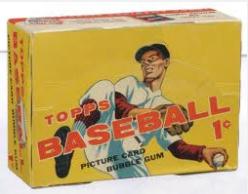
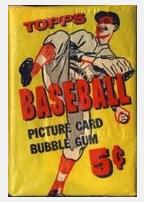
My fondness for 1956 Topps started way back in 1964 when I first started collecting as an 11 year old. My friends and I wandered nearby neighborhoods in search of “old cards”. Back then, the oldest cards we ever found in dealing with other kids were 1957 Topps.
Eventually I saw my first 1956 Topps card – I was hooked.
It was larger, thicker, fluffier making it look much, much older compared to a 1-year old 1957. “Ancient” we thought.
I changed neighborhoods in 1966 leaving my childhood friends behind.
Before I left, except for a small cigar box of my favorites, I “donated” all my cards to the neighborhood – and stopped collecting. I had a great 3 year run but sure wish I would have been collecting in 1966 and 1967 with those tough high numbers. I would have loved to have had a cigar box full of them in place of my hoard of 1964 Topps Felix Mantilla and Gary Peters cards.
The regular 1956 Topps baseball card set is one of my favorites. Topps again went with a slightly larger (3-3/4″ by 2 5/8″) horizontal card design, similar to their 1955 Topps cards. Several of the portraits are even the same used on 1955 Topps cards some even back to 1954 Topps. 1956 was Topps first issue to feature team cards and checklists. A much more boring addition was the addition of the 2 league presidents.
With Bowman gone, Topps could again make cards of Mickey Mantle missing from Topps issues since 1953. After Mickey Mantle, it is a fun and simple set to complete with no high numbers or extremely expensive rookies with Hall-of-Famer Luis Aparicio being the top rookie.
For the serious 1956 collector, there are over 200 variations, making things extremely difficult for master set collectors. Most the variations deal with card stock (gray or white backs).
Cards #1-100 gray backs scarcer with slight premium
Cards #101-180 white backs much scarcer with larger premium
… rumor has it gray outnumbers white about 9-to-1 in the above run.
There are also several cards with color line variations on front.
For example: Ted Williams’ card has either no line over his name or a thin green, red, blue, or yellow line between the white border for a total of 5 variations. Whitey Ford and Early Wynn also have no line or a thin red or yellow lines. In addition, many team cards had 3 different variations with team name either on the
Left, Center or Right.
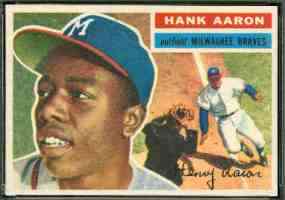
There are a few uncorrected errors, the most famous being card #31 Hank Aaron which actually pictures Willie Mays sliding home !
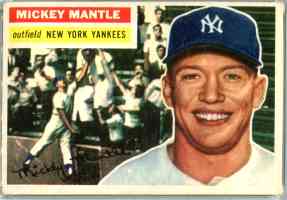
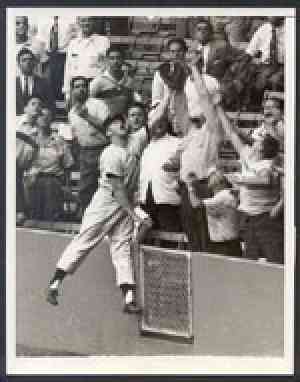
Card #135 Mickey Mantle is also an interesting card. Exciting card pictures Mantle leaping high into the stands trying to catch a home run ball. The artist did a great job and Mantle makes the catch !!!
An awesome play to put on this great card – right ?
Only problem is that on the real play, Mantle missed the ball.
And as always for vintage Topps sets, take a quick look at Don Mossi and his famous ears !
Collectors of 1956 Topps likely love Topps side issue ‘1956 Topps Pins’ which used the same portrait photos as the cards. Seems collectors preferred cards to pins and Topps cut the 1956 Topps Pin set from a planned 90 pins to just 60.
Click for complete
1956 Topps PINS Checklist and Prices



 My fondness for 1956 Topps started way back in 1964 when I first started collecting as an 11 year old. My friends and I wandered nearby neighborhoods in search of “old cards”. Back then, the oldest cards we ever found in dealing with other kids were 1957 Topps.