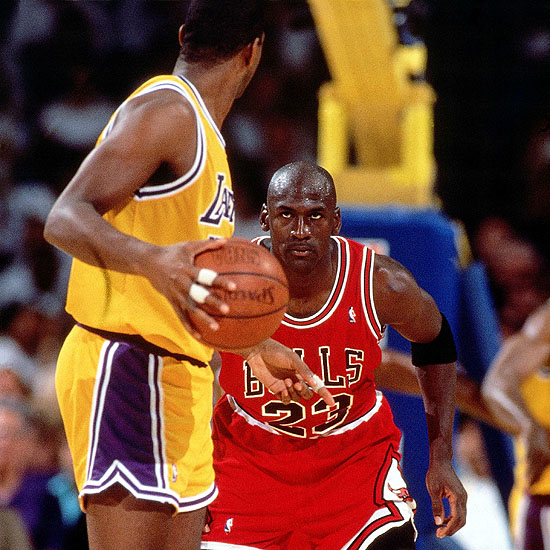
The ’91 NBA Final was the defining series for the future of the NBA for the next decade. The best player in the league would learn how to win on basketball’s biggest stage. Michael Jordan and the Bulls would win six titles including the ’91 affair. The Lakers would not see glory again until they retooled for the Kobe and Shaq era. This series was certainly a definitive passing of the torch moment.
The first stage was part abdication and the rest annihilation. The Chicago Bulls finally vanquished their long time nemesis the Detroit Pistons in a convincing sweep. For three years leading up to this moment, the Bulls made continual progress towards usurping the Pistons dynasty. Each successive time they met in the playoffs, the Bulls came closer to beating them. Finally in 1991, the Bulls overcame their most bitter of rivals. Many notable Pistons left the court with eight seconds left, in a last gasp show of defiance.
While the conference finals featured Chicago overcoming their most bitter rivals, the NBA finals were a changing of the guard on a national scale. The Los Angeles Lakers were at the end of their “Showtime” dynasty. James Worthy and Magic Johnson were at the end of their storied careers. The stranglehold the Lakers had in the Pacific Division, ended this year as Portland finished first in the division. One last run was on the plate for these Lakers, as they triumphed over Portland in six games.
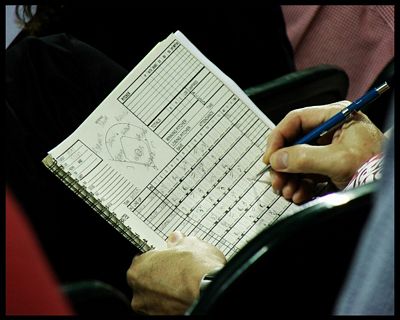
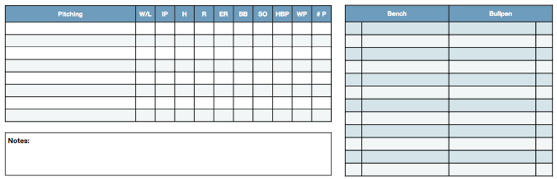
Scorekeeping is an art and everybody has their own way of doing it. I’ve created a scorecard that tracks everything you could ask for, making it easy for you to keep track of your team. The scorebook was developed to accommodate a wide variety of baseball statistics, all of which are conveniently placed on one page.
The Touch ‘Em All Baseball Scorebook is for everyone and anyone, and can be used at any level for baseball or softball. The 11 spots in the batting order and room for 11 innings prepares you for innings or games that may go longer than expected. Whether you’re a fan at home watching on television or you’re at a little league game, this scorebook is the one to use.
Features:
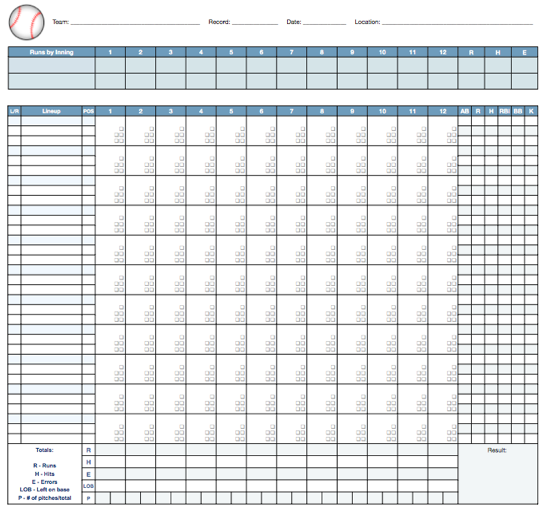
11 innings – for games that go longer than planned
11 batting slots – comes in handy when a team goes around the order or if you need more than the usual nine slots
40 lineup cards (one for each scoresheet)
Pitching stats – includes a chart for a maximum of eight pitchers per team
Hitting stats – allows you to add up and total each batter’s offensive stats
Pitch counts – not only track pitches thrown to every batter, but track the pitch count as well
Runs by inning – a simple chart that allows you to recall when runs were scored during the game
Bench and bullpen slots – list players on the bench and in the bullpen, allowing you to see which players each team has yet to use. As they enter the game, simply cross out their name to stay updated.
A box for notes – use it for anything you’d like
Here’s a screenshot of what it looks like:
The scorebook even includes a full schedule page and a roster page with contact information. Of course you don’t have to use everything, but it is there if you need it.
The scorebook also includes instructions for how to keep score, in the event that you are unfamiliar with how it works. There is a page that explains how to do it and shows you examples for those that prefer visuals to learn.
The scorebook contains 40 scoresheets, so you can track 20 games (if you track both teams) or 40 games (if you track one team).
Heading into the French Open, the second major of the season, most players prepare diligently for their final hurrah on clay. It remains as probably the least understood and least appreciated of the court surfaces players endure each year.
If the truth be told, players who learn to play on clay and who embrace the surface’s forgiving nature generally become better, more successful all-around players than those who learn the game on grass or hard courts.
The typical clay court player excels in patience by learning how to develop points as well as excellent defensive skills.
For a long time it seemed that some players segregated their careers by either avoiding clay altogether or by playing exclusively on the red dirt. But with the start of the Open Era and the necessity to play on multiple surfaces, some players built successful all-court games using clay court expertise as the foundation.
These male players achieved a top ten ATP ranking, a winning percentage in excess of 70 percent on clay throughout their careers—as well as double digit title wins on clay. Most also won at least one French Open, although not all.
Which team’s goal song will carry them to victory in the 2013 GSC?
The NHL playoffs kick off in a few hours and I really don’t think that there is a better playoff series in sports. There is nothing like playoff hockey. The tempo of the game, the physicality and the effort shown by all of the guys on the ice blows every other sport out of the water.
If you have ever been to a hockey game you know all about the goal horns that go off when a team scores. Personally, I think the horns are awesome but what I like even more are the songs that follow. Every team has their own goal song and every song, if played enough, can start to drive a visiting goalie insane.
Goal songs come in all forms. There are chants, there are up tempo songs, classic songs and songs that straight up make you want to dance. But it’s playoff time, so for 16 other teams their goal scoring days are over (at least for this season). It’s time for me to reveal my playoff bracket based on which songs are the best. I also welcome any of you to leave your comments and let me know who your Goal Song Cup winner would be.
On an incredibly EMOTIONAL night at TD Garden, Bostonians, Americans & Bruins fans sang their hearts out during the national anthem. Whether you were in the building or at home watching on television, you could not help but feel overwhelmed with sorrow, happiness and patriotism.
The Sports Then and Now Vintage Athlete of the Month is a former Chicago Cubs player and manager who is best remembered as part of a sports trio forever immortalized in verse.
Known as “The Peerless Leader”, Frank Chance was not only the starting first baseman for the Chicago Cubs, but as their manager he led the team to four World Series appearances between 1906 and 1910.